
2026 Director’s Challenge Awards
This cycle, the program supported projects in which epidemiological/population-based researchers with novel observations collaborate with lab-based or clinical researchers to investigate mechanisms or to develop potential interventions. The program made seven 2-year awards, ranging in amount from $192,000 to $221,000 per year. The currently funded projects, project leaders, and collaborating Institutes/Centers are:
- From Epidemiology to Treatment: Safeguarding Postmenopausal Women’s Health
- Ronna Hertzano in Collaboration with NIMH, NICHD, and NIEHS
- Defining Mechanisms Driving Geographic Atrophy in Age-Related Macular Degeneration Using Stem Cell-Derived New Approach Methodologies
- Tiarnán Keenan in Collaboration with NIAID
- Leveraging Genomically and Clinically Ascertained Cohorts to Characterize the RUNX1 Familial Platelet Disorder Phenotype
- Lisa McReynolds in Collaboration with NHGRI and NHLBI
- Biologic Rhythms and Environmental Contexts in Human Health: Integrating Epidemiology and Circadian Science
- Kathleen Merikangas in collaboration with NIDDK, NHLBI, NIAAA, NIA, NHGRI, Northwestern University, Nathan Kline Institute, Johns Hopkins, U Colorado, Texas A&M, and UT Southwestern
- Development and Validation of a Biomarker-Enhanced AI-Based Approach for Early Detection of Gynecological Cancers Using Cervical Cytology Slides
- Nicolas Wentzensen in Collaboration with NLM and Centrauris Med, Inc.
- Impact of Alcohol Administration on Surrogate Markers of Suicide Risk
- Carlos Zarate in Collaboration with NIAAA
- Integrating Predicted Proteomics and Polygenic Risk Scores to Enhance Risk Stratification and Clinical Prognosis in Breast Cancer
- Haoyu Zhang in Collaboration with NIEHS
From Epidemiology to Treatment: Safeguarding Postmenopausal Women’s Health
Principal Investigator (PI)
Ronna Hertzano, M.D., Ph.D. (NIDCD) in Collaboration with NIMH, NICHD, and NIEHS
Project Summary
Menopause is a natural stage of life when a woman's body produces less estrogen. This change can increase the risk of health problems such as hearing loss, sleep difficulties, depression, bone loss, and metabolic diseases like diabetes. Estrogen therapy can help reduce many of these symptoms. However, it may also increase the risk of breast cancer, uterine cancer, and blood clots, which can make some women hesitant or unable to use it. Estrogen works through two types of receptors in the body, called ERα and ERβ. Most of the serious side effects are linked to ERα. This research focuses on a new drug called K101 that selectively activates ERβ. Researchers hope this approach will provide the health benefits of estrogen while avoiding many of its risks. Studies in animals suggest that activating ERβ may help protect hearing, reduce inflammation in the brain, improve mood, and avoid changes that could increase cancer risk. In this project, researchers will use mice to model menopause and test whether K101 can help protect hearing, improve sleep, and maintain strong bones. The researchers will also carefully monitor breast, uterine, and metabolic health to make sure the treatment is safe. If successful, this work could lead to a new and safer treatment that helps women stay healthier during and after menopause.

This project investigates whether the ESR2-selective agonist K101 can safely treat menopause-associated health conditions including hearing loss, sleep disruption, and osteoporosis in ovariectomized mice while avoiding risks associated with traditional hormone replacement therapy.
Defining Mechanisms Driving Geographic Atrophy in Age-Related Macular Degeneration Using Stem Cell-Derived New Approach Methodologies
Principal Investigator (PI)
Tiarnán Keenan, M.D., Ph.D. (NEI) in Collaboration with NIAID
Project Summary
Geographic atrophy (GA) is an advanced form of dry age-related macular degeneration, a serious eye disease that can lead to blindness. It damages the retinal pigment epithelium (RPE), a layer of cells that supports the light-sensing cells in the back of the eye. There is currently no cure for GA. More than 5 million people worldwide have GA, and that number is expected to grow as the population ages. Finding effective treatments is an urgent need. Research from the National Eye Institute's Age-Related Eye Disease Studies (AREDS and AREDS2) identified two genes, CFH and ARMS2/HTRA1, as well as cigarette smoking, as the biggest risk factors for developing GA. However, scientists still do not understand exactly how these genes and smoking cause damage to the RPE. Without that knowledge, it is difficult to develop treatments that target the disease. To address this problem, we will combine three powerful research approaches from the National Eye Institute (NEI) and the National Institute of Allergy and Infectious Diseases (NIAID). First, we will study blood samples from AREDS and AREDS2 participants to identify metabolic changes linked to the start and progression of GA, while considering differences in genes and smoking history. Second, we will create laboratory models of GA using stem cells from patients that are turned into RPE cells. This will help us understand how genetic and environmental risk factors contribute to the disease. Third, we will test thousands of approved drugs in these cell models to identify treatments that may slow or stop GA and to predict which patients are most likely to benefit. This research pipeline—from patient samples to laboratory models to drug testing—provides a clear path toward developing treatments for a disease that causes vision loss and blindness.

A. Optical coherence tomography image of an eye with geographic atrophy, showing loss of retinal pigment epithelium in the GA area and sub-RPE drusen deposits, including the deposit marked by an asterisk.
B. Micrograph of polarized patient-derived stem cell RPE cultured on a transwell membrane and exposed to a GA-relevant stressor. APOE-positive drusen-like deposits are visible beneath the RPE, modeling key features of AMD pathology.
Leveraging Genomically and Clinically Ascertained Cohorts to Characterize the RUNX1 Familial Platelet Disorder Phenotype
Principal Investigator (PI)
Lisa McReynolds, M.D., Ph.D. (NCI/DCEG) in Collaboration with NHGRI and NHLBI
Project Summary
RUNX1-FPDMM is an inherited disorder that can cause easy bruising, bleeding problems, a higher risk of blood cancers, and issues with the immune system that lead to inflammation. Recent research suggests that it may be the most common inherited platelet disorder, affecting thousands of people in the United States. However, many people who carry a harmful RUNX1 gene change may not know they have the condition. Inflammation is known to play an important role in many bone marrow disorders. It can contribute to blood problems and cause symptoms throughout the body. Studies suggest that inflammation is also important in RUNX1-FPDMM. However, researchers do not yet know how common this disorder is in the general population or how often people with the disorder experience inflammation compared with people who do not have it. In this project, we will answer these important questions and learn more about how inflammation affects people with RUNX1-FPDMM. Using large genetic and health databases, we will estimate how common the disorder is and measure how often inflammation and other symptoms occur in affected individuals. At the same time, we will study hundreds of patient samples that have been collected in a large research biobank. We will look for signs of inflammation and other biological markers that may help explain how the disease develops. This work will improve our understanding of RUNX1-FPDMM and may help identify new targets for future treatments.

RUNX1-Familial Platelet Disorder with Myeloid Malignancy predisposition is germline genetic disorder that predisposes individuals to thrombocytopenia and development of leukemia. We will combine data from the RUNX1 natural history study and large genotype-first sequencing efforts to elucidate mechanisms of FPDMM.
Biologic Rhythms and Environmental Contexts in Human Health: Integrating Epidemiology and Circadian Science
Principal Investigator (PI)
Kathleen Merikangas, Ph.D. (NIMH) in collaboration with NIDDK, NHLBI, NIAAA, NIA, NHGRI, Northwestern University, Nathan Kline Institute, Johns Hopkins, U Colorado, Texas A&M, and UT Southwestern
Project Summary
Our daily routines—such as when we sleep, exercise, eat, think, and feel—play an important role in our health. In large studies of people, we found that problems with these 24-hour body rhythms are common in many mental and physical health conditions. We also found that activity patterns are closely linked to depression, heart disease risk, and metabolic health. Because these rhythms are often inherited, they may be controlled by basic biological systems that affect many different chronic diseases and could be changed through treatment. At the same time, studies in animals and other research models have identified genes and biological processes that help control daily rhythms. This project brings these discoveries together. By expanding the NIH Clinical Center's Rhythms and Blues study, we will combine population research with laboratory testing, wearable technology, metabolic measurements, and genetic studies across different species. By collecting detailed information from participants over days and seasons, we can study how body rhythms change over time and how they interact with other aspects of health. Instead of looking at a single snapshot, we can follow these patterns as they happen in real life. By connecting large-scale human studies with basic biology and tracking daily rhythms over time, this NIH collaboration aims to improve our understanding of how the body's internal clock affects health. This knowledge could lead to more personalized ways to prevent and treat many chronic diseases.

The figure shows the framework for this project that: a) integrates findings from lifespan epidemiologic studies that have identified common regulatory domains underlying chronic medical and mental conditions including sleep, motor activity, emotion and cognition. b) characterizes patterns and dynamics of these domains and their interrelationships with real time digital toolkits in daily life environments. c) examines biologic systems and genetic factors involved in regulation of these systems through basic science research and multipronged genetic approaches. d) derives individualized profiles that support personalized interventions and inform population health strategies. Continuous feedback across all domains accelerates discovery, translation, and implementation.
Development and Validation of a Biomarker-Enhanced AI-Based Approach for Early Detection of Gynecological Cancers Using Cervical Cytology Slides
Principal Investigator (PI)
Nicolas Wentzensen, M.D., Ph.D. (NCI/DCEG) in Collaboration with NLM and Centrauris Med, Inc.
Project Summary
Endometrial and ovarian cancers affect nearly 90,000 women in the United States each year, and about 27,000 women die from these diseases. One major challenge is that there are currently no effective ways to find these cancers early, when treatment is most likely to be successful. Previous research has shown that cancer cells from the uterus and ovaries can sometimes be found in cervical screening samples, such as those collected during a Pap test. However, these cancer cells are very rare and are mixed with many normal cells, making them difficult to identify using traditional methods. In this project, we will develop a new approach that combines a special laboratory stain with artificial intelligence (AI) to improve cancer detection. We will use a marker called Ki-67, a protein that is commonly found in gynecological cancer cells, to help highlight cells that may be cancerous. We will then train an AI system to recognize these cells in cervical screening samples from women with and without cancer. Using large collections of cervical cytology slides, we will develop and test the AI model to make sure it works accurately. If successful, this method could be a major step forward in the early detection of endometrial and ovarian cancers. Because it uses the same type of sample already collected for routine cervical cancer screening, this approach could be tested in existing screening programs and adopted widely. This could help detect more cancers earlier and improve outcomes for many women.

Development of an AI-based approach to identify ovarian and endometrial cancer cells in routine samples from a population-based cervical screening program.
Impact of Alcohol Administration on Surrogate Markers of Suicide Risk
Principal Investigator (PI)
Carlos Zarate, M.D. (NIMH) in Collaboration with NIAAA
Project Summary
Thousands of Americans die by suicide each year, and many more die from health problems related to alcohol use. Previous research in large groups of people has shown that alcohol and other substance use disorders are major risk factors for suicidal thoughts and behaviors. However, scientists still do not fully understand how alcohol increases the risk of suicide. Because of this, healthcare providers have limited tools to help people who may be at risk. Suicidal behavior often develops when several factors come together, including strong emotional pain, unconscious thoughts about death, and difficulty making good decisions. Researchers have not yet tested how alcohol affects these important processes in the brain. In this study, scientists from the National Institute of Mental Health (NIMH) and the National Institute on Alcohol Abuse and Alcoholism (NIAAA) will work together to better understand the connection between alcohol use and suicide risk. They will use brain imaging and behavioral tests to examine how alcohol affects emotions, thinking, and decision-making. Using a technology called magnetoencephalography (MEG), researchers will measure brain activity in real time while participants complete these tasks. They will focus on brain regions involved in emotional distress and self-awareness, including an area called the anterior insula. This research will help scientists better understand how alcohol affects the brain in ways that may increase suicide risk. The findings could lead to new treatments and prevention strategies that reduce the impact of alcohol on suicidal behavior and help save lives.
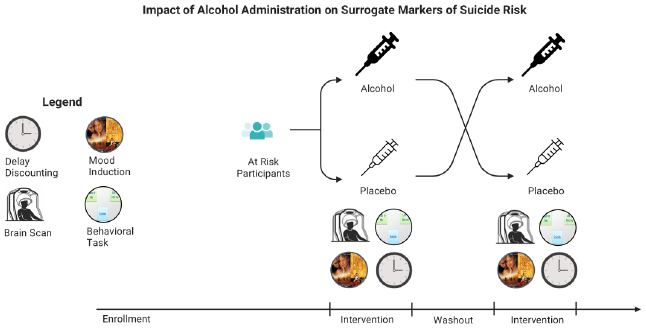
A schematic diagram of the study design to evaluate the relationship of intravenous (IV) alcohol to suicide risk factors. IV alcohol will be administered during magnetoencephalography (MEG) scanning to individuals with mild to moderate depression. After the IV alcohol administration, participants will complete a series of behavioral tasks including delay discounting and watching a sad movie clip as a mood induction.
Integrating Predicted Proteomics and Polygenic Risk Scores to Enhance Risk Stratification and Clinical Prognosis in Breast Cancer
Principal Investigator (PI)
Haoyu Zhang, Ph.D. (NCI/DCEG) in Collaboration with NIEHS
Project Summary
Breast cancer is the most commonly diagnosed cancer in women in the United States and is a leading cause of cancer-related death. Scientists can use genetic information to estimate a woman's inherited risk of developing breast cancer. One tool, called a polygenic risk score (PRS), combines the effects of many genes to predict risk. However, PRS can be difficult to understand biologically, may not work equally well for people from different backgrounds, and does not directly identify targets for prevention or treatment. This project will develop a new tool called a Protein Risk Score (ProRS). Instead of looking only at genes, ProRS uses genetic information to predict levels of proteins in the blood. Because proteins help carry out many important functions in the body, studying them may provide clues about how breast cancer develops and how it can be prevented or treated. Researchers will use data from several large studies involving millions of people from different backgrounds. They will test whether combining PRS and ProRS can better identify women at higher risk for breast cancer and predict different types of the disease. The team will also study how environmental factors, such as lifestyle and other exposures, may interact with inherited risk. In addition, they will examine data from more than 50,000 breast cancer patients who participated in clinical trials to determine whether PRS and ProRS can help predict cancer recurrence, survival, and side effects from treatment. The goal of this research is to create better tools for identifying breast cancer risk, understanding the biology of the disease, and improving prevention, screening, and treatment. The project will also identify important proteins and biological pathways that could become targets for future therapies.

Integrating inherited genetic risk and genetically predicted proteins to improve breast cancer risk prediction, prevention, and clinical prognosis across diverse populations.
This page was last updated on Tuesday, June 30, 2026